Digital transformation without mandate: how to reach the decision-maker
In many SME organizations, the IT manager is the person who knows the most about technology, works the hardest, and has virtually no mandate. Budgets are approved elsewhere, strategic choices are made by people who don’t understand the technology, and when something goes wrong, IT is the first to get the call.
This is not the exception; it is the norm.
The IT manager’s dilemma
We see it regularly: an IT manager who knows exactly what needs to happen. The current platform is too expensive, too slow, and too fragile. A better architecture is possible, and the technical analysis is airtight.
But nothing changes.
This happens not because the analysis is wrong, but because the person making it is not the person signing off on it. The IT manager can have a rock-solid case for why the current system needs to be replaced, but if that case doesn’t reach the right person in the right language, it remains a frustrating PowerPoint that nobody reads.
Mapping the organizational environment
Before you even think about architecture diagrams or migration plans, you need to map the organizational environment. That sounds abstract, but it is very concrete:
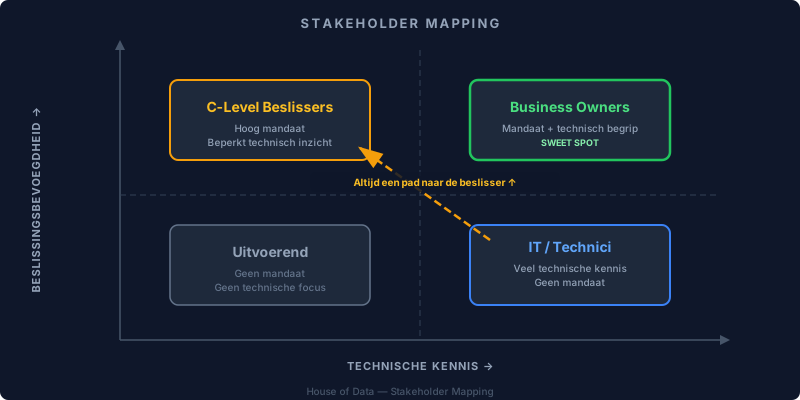
- Who has decision authority? Not who should decide, but who actually signs off on expenditures above a certain threshold.
- Who has technical knowledge? Who understands what happens under the hood and can assess the impact of changes?
- Who benefits from the status quo? Every existing architecture has stakeholders with a vested interest in its continued existence, such as vendors with running contracts, department heads protecting their budget, or employees whose position depends on knowledge of the current system.
Once you have mapped this, you know exactly where you stand. Often the picture is sobering: the people with knowledge sit in the bottom-right quadrant (lots of technical insight, no mandate), while the decision-makers sit in the top-left (lots of authority, limited technical understanding).
Speaking two languages
This is where most technical initiatives fail: communication happens only in a technical language. Architecture diagrams, latency comparisons, and cost models are all relevant, but they are unreadable for the average CFO.
Effective digital transformation requires two simultaneous communication strategies:
For technical stakeholders: Provide architecture diagrams, proof-of-concepts, and detailed cost models. This is the evidence that the proposed solution works. It is where you convince the IT manager, the architect, and the engineer.
For the C-level decision-maker: Explain what it costs when things go wrong. Discuss what competitors are doing and how much time is lost with the current system. Present concrete figures in euros and risks.
A CFO is not interested in the fact that the current analytics platform is suboptimal for columnstore queries. But that same CFO is very interested when it turns out the organization is paying thousands of euros per month for a system that is slower than the old on-premise server, especially when there is an alternative that is 70% cheaper.
Same message, different language.
The path to the decision-maker
An IT manager who is enthusiastic about a new technological capability is valuable as an ally, but that person cannot sign a contract.
As an external advisor, we always ensure a path to the decision-maker. This does not mean bypassing the IT manager; on the contrary, they are essential for the technical foundation. However, the IT manager alone is not enough.
In practice, this means:
- Start with the technical stakeholder. Build the business case together and use their knowledge of the current environment.
- Translate the story. Create a version of the same business case that requires no technical background, focusing on costs, risks, and competitive position.
- Identify the decision-maker. Not the person who says “yes, good idea” in a meeting, but the person who releases budget.
- Create the moment. A business case without a trigger becomes a report in a drawer. Tie your proposal to a concrete moment, such as a contract renewal, an incident, or a budget cycle.
The real transformation is organizational
Technology is rarely the problem, and architecture is rarely the stumbling block. What causes digital transformation to fail is the inability to translate technical insights into decisions at the right level.
Those who understand this and act on it transform not just the technology, but the way the organization makes decisions about technology. That is a change that lasts.
Struggling with digital transformation? Get in touch for an initial consultation.