How We Reduced the IT Budget by 60% Without Sacrificing Quality
A growing e-commerce company, operating internationally, but stuck in a technical dead end. The webshop ran on heavily customized Magento, demanding more maintenance than it allowed for innovation. On the work floor, staff had to check five different applications just to serve a single customer. Freelancers in every seat, dutifully running sprints, but the organization wasn’t moving forward. And the IT budget? Growing faster than revenue.
The problem is rarely the technology
Most IT departments grow organically. A project comes along, so a freelancer is hired. An outage occurs, and another server is added. Before you know it, you have a patchwork of systems, contracts, and people, with no one overseeing the big picture.
This company was no different:
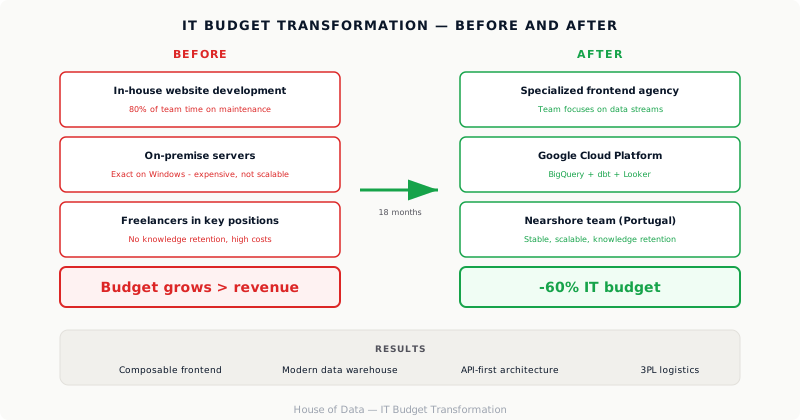
- In-house website development was consuming 80% of the team’s time.
- On-premise servers running Exact on Windows: expensive to manage and impossible to scale.
- Freelancers in key roles, leading to high costs and no knowledge retention.
What we did
Instead of a “big bang” approach, we reoriented the organization in strategic phases.
1. Shift focus from building to connecting
We moved away from in-house website development. The frontend was outsourced to a specialized agency and integrated via a new integration layer. The internal team shifted its focus to where the real value lay: data flows.
2. Transform the team
Freelancers were gradually replaced by a nearshore team in Portugal. This wasn’t about cutting quality, but about building a stable, scalable team with lower costs and better knowledge retention.
3. Move to the cloud
The on-premise environment was migrated to an external data center. Simultaneously, we built a modern data platform on Google Cloud:
- Landing zone in BigQuery: centralizing all data.
- Transformations with dbt: making data reliable, testable, and documented.
- Reporting in Looker: creating dashboards that the business actually uses.
4. API-first strategy
We implemented an integration platform on Google Cloud using Cloud Run and Pub/Sub. We moved away from point-to-point connections toward a scalable, event-driven architecture that grows with the business.
The result
Within 18 months, the IT budget had decreased by 60%. More importantly, the organization could move forward again:
- A new composable webshop frontend.
- A modern data warehouse providing the basis for AI and machine learning.
- An internal team focused on value creation rather than maintenance.
- 3PL implementation for logistics optimization.
The takeaway
Cost reduction should not be a goal in itself; it is a byproduct of the right strategic choices. When an IT budget spirals out of control, the question shouldn’t be “where can we cut?” but “where are we actually creating value?”
That is precisely the first question we ask at House of Data.
Want to know how your IT organization can be more efficient? Get in touch for an initial consultation.